
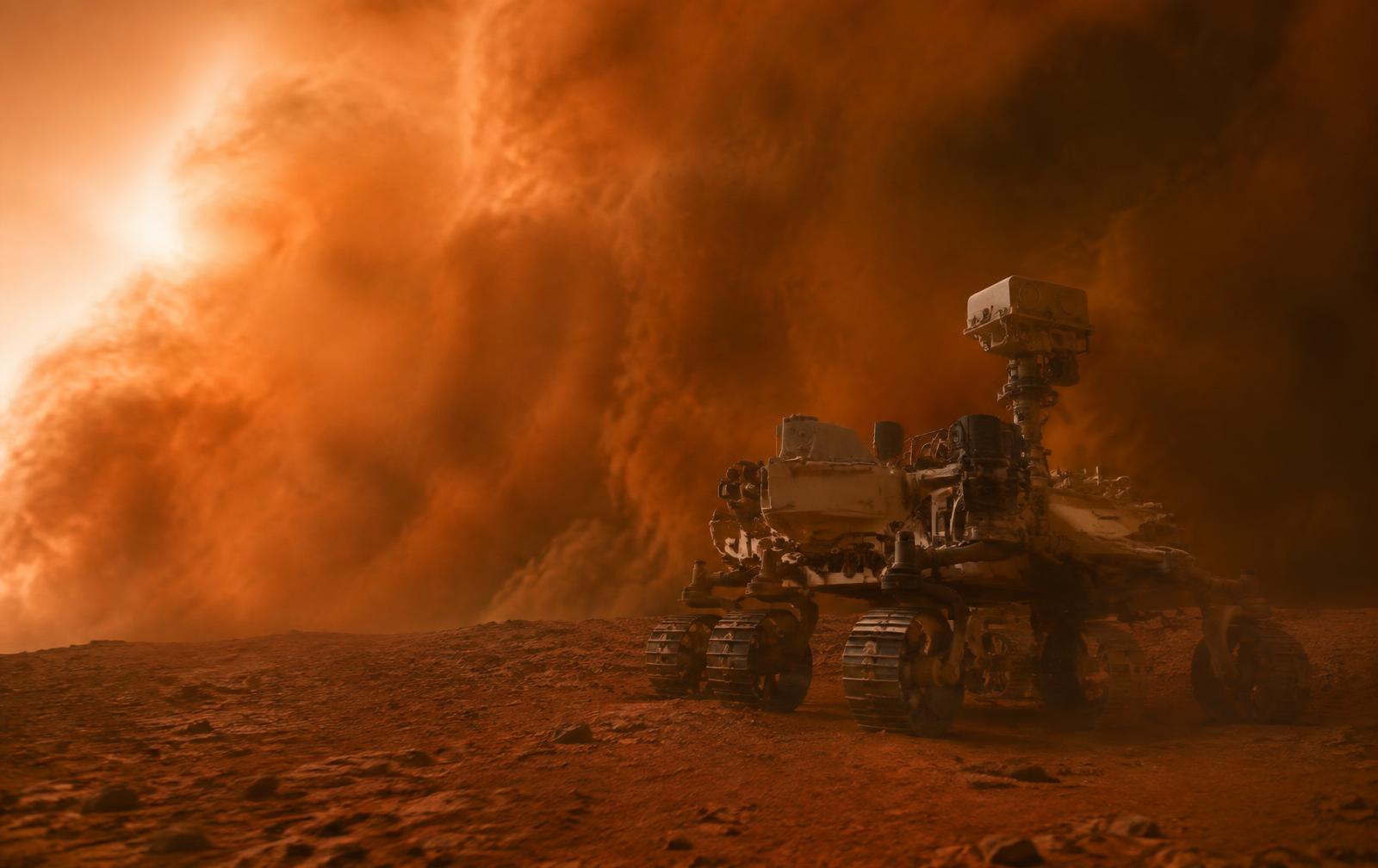
Dust & Radiation Shield keeps hardware operating through the two environmental factors that damage it most on Mars: fine, abrasive dust and high-energy radiation. Global storms, dust deposition on optics and solar arrays, and solar particle events all change what a robot can safely do. The programme detects these conditions early, translates them into concrete effects per unit and issues protective actions before conditions degrade further.
- Dust-storm and radiation-event detection with arrival forecasting
- Per-unit power, contamination and dose effect modelling
- Automated safe-mode and shelter-seeking recommendations
- Fleet-wide power and exposure budgets during disturbed periods
On-unit intelligence
Dust optical depth and particle-radiation data are classified directly on each unit, so a developing storm or radiation event is recognised within minutes. The unit transmits a prioritised warning with expected effects instead of raw sensor imagery, and the forecast is refined by ground-based atmosphere models.
Atmosphere and radiation monitoring
Camera-derived dust optical depth, local pressure and temperature, and on-board radiation dosimeters are ingested continuously. Classifiers running on each unit flag rising dust activity and characterise particle events as they arrive, hours to days ahead depending on the phenomenon.
Effect modelling per unit
A generic storm warning is of little use in the field. The programme maps each event to the individual unit: expected solar-array power loss, dust accumulation on optics and seals, radiation dose to electronics, and the resulting change in safe operating envelope.
Protective actions
The system recommends and, where authorised, schedules safe-mode transitions, mast and panel stowing, shelter-seeking manoeuvres, and re-planning of traverses and communication windows around the disturbed period.
Fleet-wide effects
The same event picture supports fleet planning: reduced solar-charging forecasts, visibility loss for optical navigation, and radiation exposure budgets across all deployed units.
Recovery and post-event analysis
After the storm the programme reconstructs what each unit actually experienced, compares it with the forecast and feeds the difference back into the models, so every event makes the next warning more precise.