
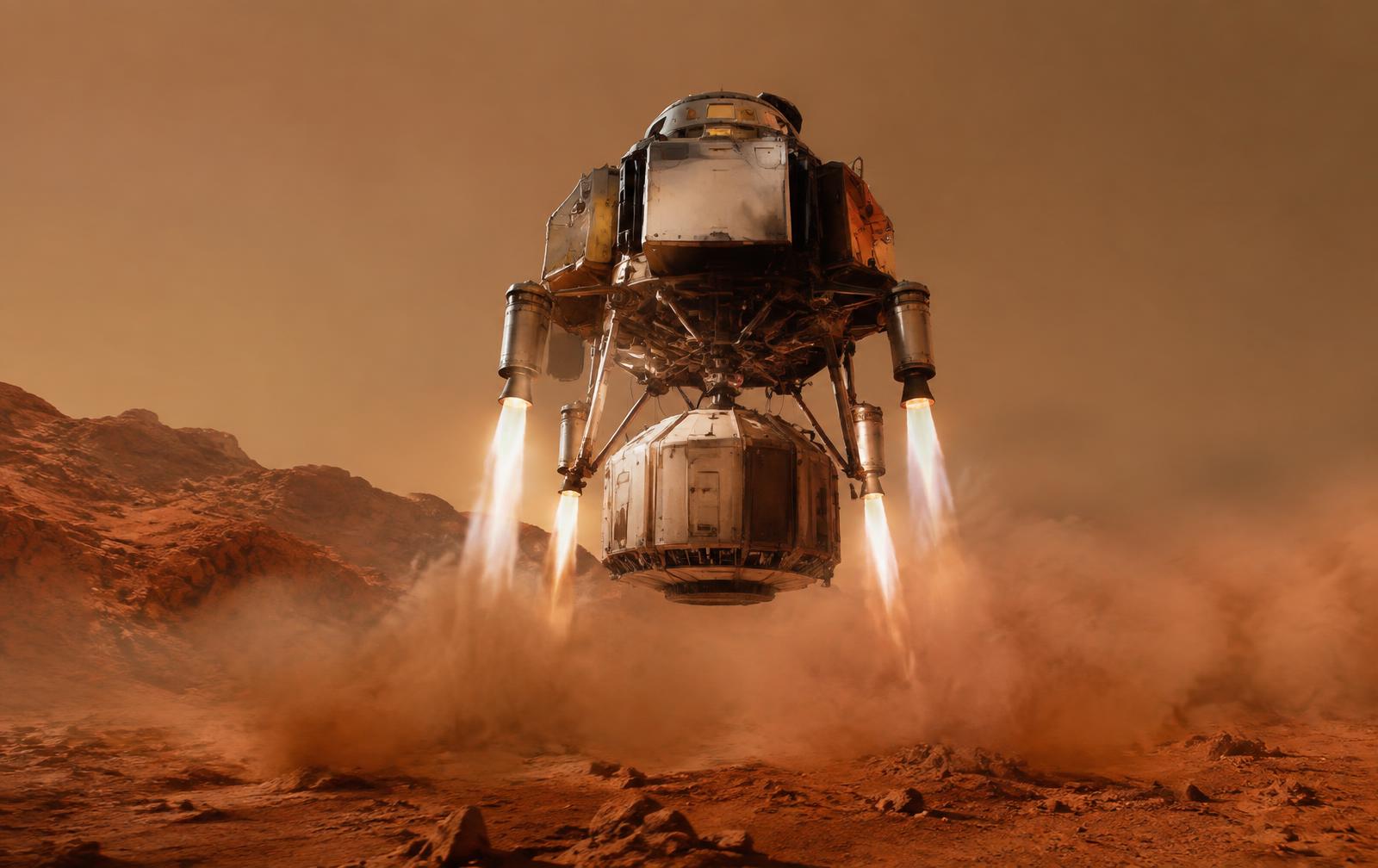
Descent Control lands hardware exactly where the mission needs it. The programme determines the entry corridor, guides the powered-descent phase and, where possible, shapes touchdown into a tight ellipse next to previously landed assets, so habitat and infrastructure modules arrive within walking distance of each other.
- Landing window narrowed continuously from atmosphere and dust data
- Divert manoeuvres shaped into cleared touchdown ellipses
- Real-time hazard detection and autonomous retargeting
- Direct coordination with mission planning and surface assets
On-lander intelligence
Atmospheric density, drag behaviour and terrain-relative position are evaluated on board as they are sensed. The AI keeps the landing solution current through the descent and downlinks a prioritised status update whenever the ellipse shifts materially - the final touchdown point is confirmed by ground-based trajectory reconstruction.
Entry protection
Atmospheric density is the dominant uncertainty during entry. We combine seasonal atmosphere models, dust-storm forecasts and observed drag behaviour to continuously narrow the landing window as the vehicle descends and keep the guidance solution within its control authority.
Ellipse shaping
For vehicles with propulsive terminal descent, the programme designs divert manoeuvres that place touchdown inside a cleared zone next to existing infrastructure, balancing propellant margin against terrain hazard.
Hazard-relative navigation
Terrain-relative navigation and hazard detection during the final descent phase identify rocks, slopes and depressions in real time, retargeting the touchdown point autonomously when the planned site proves unsuitable.
Mission coordination
Landing windows, ellipse updates and touchdown confirmation are shared with mission planning and other surface assets, so follow-on operations - unloading, assembly, first traverse - can start immediately.